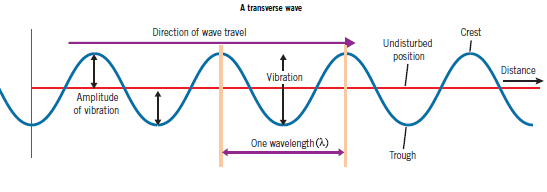
- Describing Waves:
- Equilibrium Position (undisturbed position) - when the resultant force acting is zero;
- A Complete Oscillation - when the movement or force returns to the starting value (and rate of change);
- Amplitude - the maximum displacement, distance moved, or magnitude of force on a vibrating body or wave measured from the equilibrium position;
- Time Period - the time taken to complete one oscillation (usually with unit of second, );
- Wavelength - the distance for one complete oscillation (usually measured in metres, );
- Frequency - the number of complete oscillations in a given time frame (usual cycle/second or ).
Wave Equation
- where
- is the Speed of the progressive wave, ;
- is the Frequency of the oscillation of the wave, ;
- and
- is the Wavelength, .
Related Equations:
Properties of Waves
Electromagnetic Waves and the EM Spectrum
Prereqisite Materials:
Waves
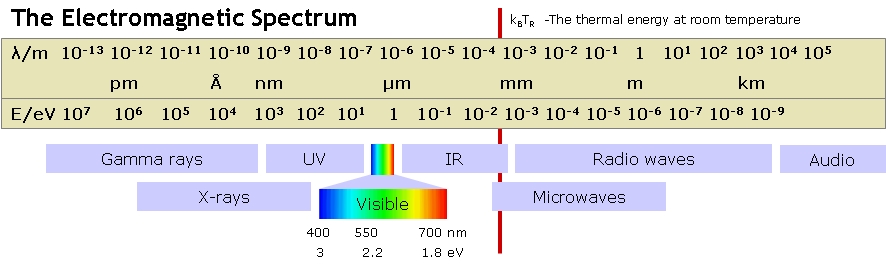
| Electromagnetic spectrum | ||||
|---|---|---|---|---|
| Name | Wavelength /m[1] | Frequency /Hz[1] | Photon energy /eV[1] | |
| Gamma Rays (-ray) | < 0.01 nm | > 30 EHz | > 124 keV | |
| X-ray | 0.01 nm – 10 nm | 30 EHz – 30 PHz | 124 keV – 124 eV | |
| Ultra-violet (U.V.) | 10 nm – 400 nm | 30 PHz – 750 THz | 124 eV – 3 eV | |
| Visible | 400 nm – 750 nm | 750 THz – 400 THz | 3 eV – 1.7 eV | |
| Infra-Red (I.R.) | 750 nm – 1 mm | 400 THz – 300 GHz | 1.7 eV – 1.24 meV | |
| Micro-wave (µ-wave) | 1 mm – 1 m | 300 GHz – 300 MHz | 1.24 meV – 1.24 µeV | |
| Radio | ≥ 1 m | ≤ 300 MHz | ≤ 1.24 µeV | |
[1] these figures are approximate.
It is useful for I/GCSE to have a knowledge of the wavelengths and/or frequency of visible radiation. You can memorise one and use to find the other.
Similarly for "A level", memorise either wavelength, frequency or photon energy and use the wave equation and Planck's law, .
Light is an example of an electromagnet wave and therefore part of the electromagnetic spectrum. All parts of the electromagnetic spectrum have the following properties:
- they are transfer waves;
- like all waves, they transfer energy from one place to another;
- they follow the wave equation:
- they travel through a vacuum;
- they travel at (even more approx. ) in vacuum, but slower in any medium.
Further Reading and Questions:
- I/GCSE
- Properties of EM Waves
- (Care of studymind.co.uk)
- EM Waves GCSE Questions (medium)
- EM Waves GCSE Questions (hard)
- (Care of www.savemyexams.co.uk)
- EM Waves Questions
- (Care of www.physicsandmathstutor.com)
Further Reading:
Electromagnetism
Ray Diagrams