| Z | |||
| νe | νµ | ντ | W± |
Prerequisite Material:
Fundimental Particles

Fundamental Interactions
| Interaction | Range | Particles Effected |
Exchange Particles |
|---|---|---|---|
| Strong | <5fm | Hadrons (All quark containing particles) |
Gluons in hadrons, pions between hadrons |
| Weak | ~0.01fm | Quarks and Leptons |
,
(and ) |
| Electromagnetic | zero to infinity | All charged particles | photon |
| Graviational | zero to infinity | All massive particles | "Graviton" (Theorised but not confirmed) |
Classification of Particles
| particles | leptons | e.g., Electron, Muon, neutrino | |
| hadrons | mesons | e.g., pion, kaon | |
| baryons | e.g., proton, neutron | ||
| anti-particle | mirror of the above i.e. the charges and quantum numbers have the opposite sign | ||
Questions:
Particle Physics and The Standard Model
Quantum Physics Questions (Care of www.physicsandmathstutor.com)
Hadrons
Hadrons are quark material. There are two type of hadron particle: baryons and mesons. Baryons consist of three matter quarks and mesons consist of one matter quark and an anti-matter quark.
Mesons
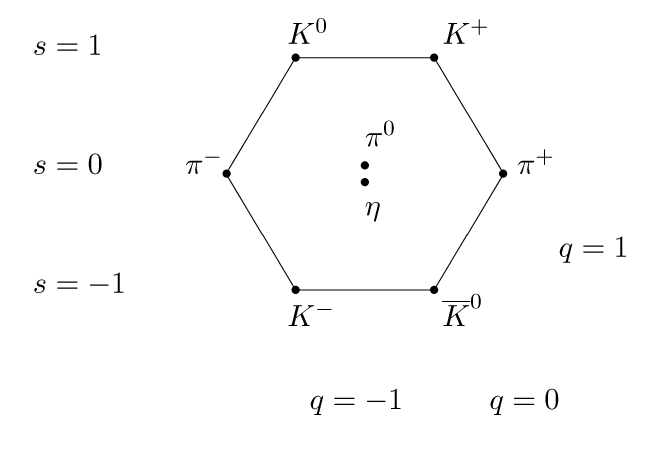
Baryon

| Common Name | Isospin Name | Quark Structure |
|---|---|---|
| proton | uud | |
| neutron | udd | |
| - | Σ+ | uus |
| - | dds | |
| - | Σ0, Λ | uds |
| - | uss | |
| - | dss |
This is not an exhaustive list of baryons
Questions:
Quarks
(Care of mmerevise.co.uk)
Particle Detectors
- When charged particles move through any medium, such as a gas, they transfer energy to it
- This is usually through the process of ionisation (The removal of one or more electrons from an atom, leaving it with a charge).
- High-energy ions transfer some of their energy to surrounding atoms, removing electrons
- The ions and electrons produced are then accelerated by applied electric fields
- Once these are discharged they form pulses of electric current
- Each pulse of electricity is counted by electronic counters connected by electrodes
- 'Counts' are then interpreted as detection of individual particles
- Ionisation is the principle by which many particle detectors operate, such as in:
- Geiger-Muller tubes;
- Spark chambers;
- Gas and cloud chambers;
- Bubble Chambers.
Detectors are needed to reveal the paths of the particles produced in experiments using particle accelerators.
Bubble Chamber
Filled with liquid hydrogen, the pressure is suddenly released so that the hydrogen is ready to vaporise. Charged particles entering the chamber ionise the hydrogen. This triggers vaporisation, so a trail of bubbles is formed along the track of each particle.

Drift Chamber
A gas filled chamber, containing typically thousands of parallel wires. Incoming particles cause a trail of ionisation in the gas. Their track is calculated electronically by the length of time ionisation electrons take to drift to the nearest sense wires. A computer processed the signals and displays the tracks graphically.

Planck's Law
Prerequisites
Describing the Planck's Law
Word equation:
The algebra:
- where
- is the energy of the photon in joules, ;
- is planck's constant in joule seconds;
- and
- is the frequency of the EM-wave in hertz, .