x
Most students know of Pythagorus' Theorem, but where does it come from?
Warm-up:
The Problem:
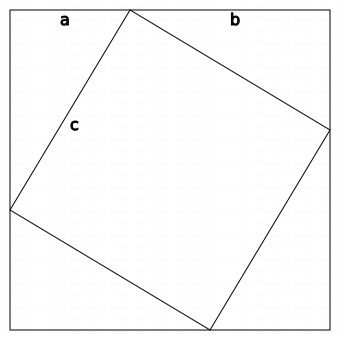
A square of side has a smaller square of side inscribed.
Find the area of the big square, the small square and the four triangles in terms of , , and . Use these areas to proof pythagoras' theorem.
-/|\-
Solution:
The area of one of the triangles is
The area of the large square is
and for the small
Using the diagram to aid combining these areas
As required
Further Reading:
Pythagoras' Theorem
(Care of thirdspacelearning.com)
GCSE Maths Proof - Revision and Worksheets
(care of mmerevise.co.uk)
-oOo-