Radioactivity is the process by which nuclei of unstable atoms change and emit particles. All elements have isotopes which have unstable nuclei. By emitting radiation these nuclei change into more stable nuclei of the same element or of a different element. This is different from chemical reastions where electons are exchanged or shared, with radioactivity changes occur in the nucleus. The decay of an unstable nucleus is a random process dependant only on the structure of the nucleus and is uneffected by temperature or chemistry.
Main Types of Radiation
| Name | Symbol | Constituents | Mass / Da | Charge / e | Relative Penetration | Relative Ionizing Strength | Relative Energy |
|---|---|---|---|---|---|---|---|
| Alpha Particles |
or |
two protons and two neutrons,
i.e., a helium-4 nucleus, |
4 | +2 | Least, ~5cm in air. Stopped by paper. | Strongest | Low |
| Beta Particles |
or |
fast moving electrons. They are produced in nuclei when a neutron changes into a proton and an electron. | ~ 0 | -1 | ~ 20cm in air, but stopped by a few mm of | Weaker than but much stronger than | More than but very much less than |
| Neutrons | Neutrons | 1 | 0 | - | - | - | |
| Gamma Rays | high frequency electromagnetic waves | 0 | 0 | Potentially never stopping. Intensity reduced by a few mm of | Weak | The most energetic |
Questions
Radioactivity
(Care of revisionscience.com)
Nuclear Radioactivity
(Care of mmerevise.co.uk)
GCSE Radioactivity
(Care of www.thesciencehive.co.uk)
Graph of Stability of Nuclei

Activity & Half-Life
When a nucleus under goes decay it looses energy or mass. In the case of mass loss, changing from one isotope to another (and quiet often of a different element). It is impossible to predict which nucleus will decay in a sample. Every nucleus has the same probability of decaying, that is, the process of decay is completely random.
However, if there are enough nuclei in our sample then a fixed proportion will decay. The fixed proportion is given by where is the probability of an individual nucleus decaying in a given time frame (usually per second) and is the number of original isotope nuclei and is known as the decay constant.
The decay rate can be measured and is called the activity, measured in Becquerel, Bq:
where is the time taken, in seconds, to record the activity.
The activity is also given by
as the activity will be equal to the number of nuclei decaying.
Therefore,
the negative sign indicating that this is a decay, i.e., the number of nuclei decreases.
Taking the limit as then this becomes
The solution to this equation is attained through integration:
where is the number of the original nuclei remaining and is the initial number of nuclei of the particular isotope under consideration.
This is an exponential decay and when plotted gives a curve. Obtaining useful information about the decay from this curve can be more difficult than from a straight line, but a straight line form of the equation can be created by an algebraic process called linearisation.
The linearisation of
is
This is of the form where , , and . So plotting a graph of versus , the gradient gives and the -intercept gives .
Half-Life,
The half-life of a radioactive material is the time taken for the number of a particular radiactive nuclei to half. If can be found from the decay constant and visa-versa by
This equation is derived as follows:
At time , . Substitute this into we get:
As required.
A radioactive isotope may emit energy as photons of a specific energy, . The power (energy transferred per second), , where is the activity, that is, the number of decays per second. Half life, is the time taken for the number of the original isotopes to decrease to half the initial mass, or, time taken for the activity to half.
Alpha Particles / Alpha Radiation
For example:
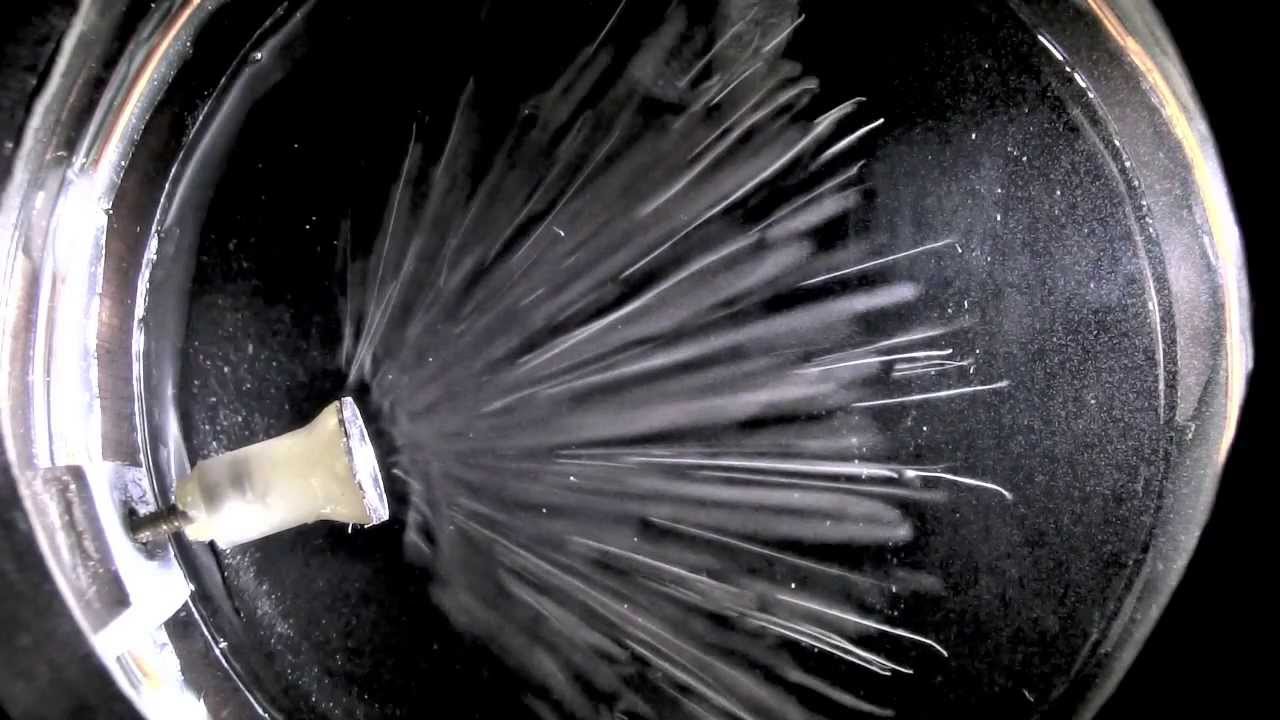
Alpha particle tracks in a cloud chamber.
You are not "seeing" the alpha particles, but the droplets of liquid created by the passing of the alpha particle.