Prerequisite Materials:
Angular Displacement and Angular Velocity
When an object moves in periodic motion the movement is often measure by the angle through which the object has moved. This is called the angular displacement and is measured in radians.
The rate at which the object moves in periodic motion is called the angular velocity. Often in SHM this is called angular frequency. This is angular equivalent of what we now need to call linear velocity.
Which in the limit is ...
Frequency Equations
- where
- is the frequency of the motion in hertz, ;
- is the time period of the motion in seconds, ;
- and
- is the anglar speed (or frequency), .
Oscillators
There are many examples of oscillating motion, including a simple pendulum, a mass on the end of a spring, the end of a ruler hanging over the edge of a desk, or a volume of water in a U-shaped tube. All share a set of similar characteristics. In each case the object starts in the equilibrium position. A force is then applies to the object to displace it, and so oscillates.
Consider an object that is displaced from equilibrium and then released. It travels towards the equilibrium position at increasing speed. It slows down once beyond its equilibrium position and eventually reaching maximum displacement (equal to the amplitude). It then returns towards equilibrium, speeding up, and once more slows down to a stop when reaching its maximum negative displacement. This motion is repeated, but not neccessarily indefinately.
Terminology
| Quantity | Symbol and unit | Definition |
|---|---|---|
| displacement | the distance from equilibrium | |
| amplitude | the maximum displacement from equilibrium | |
| period | the time taken to complete one oscillation | |
| frequency | the number of complete oscillations per unit time | |
| phase difference | used to compare the differences in displacement between two or more oscillating objects or the displacement of an oscillating object at different times. |
Simple Harmonic Motion
If records of displacements over time are made for oscillatory motion the following graphs are can be drawn
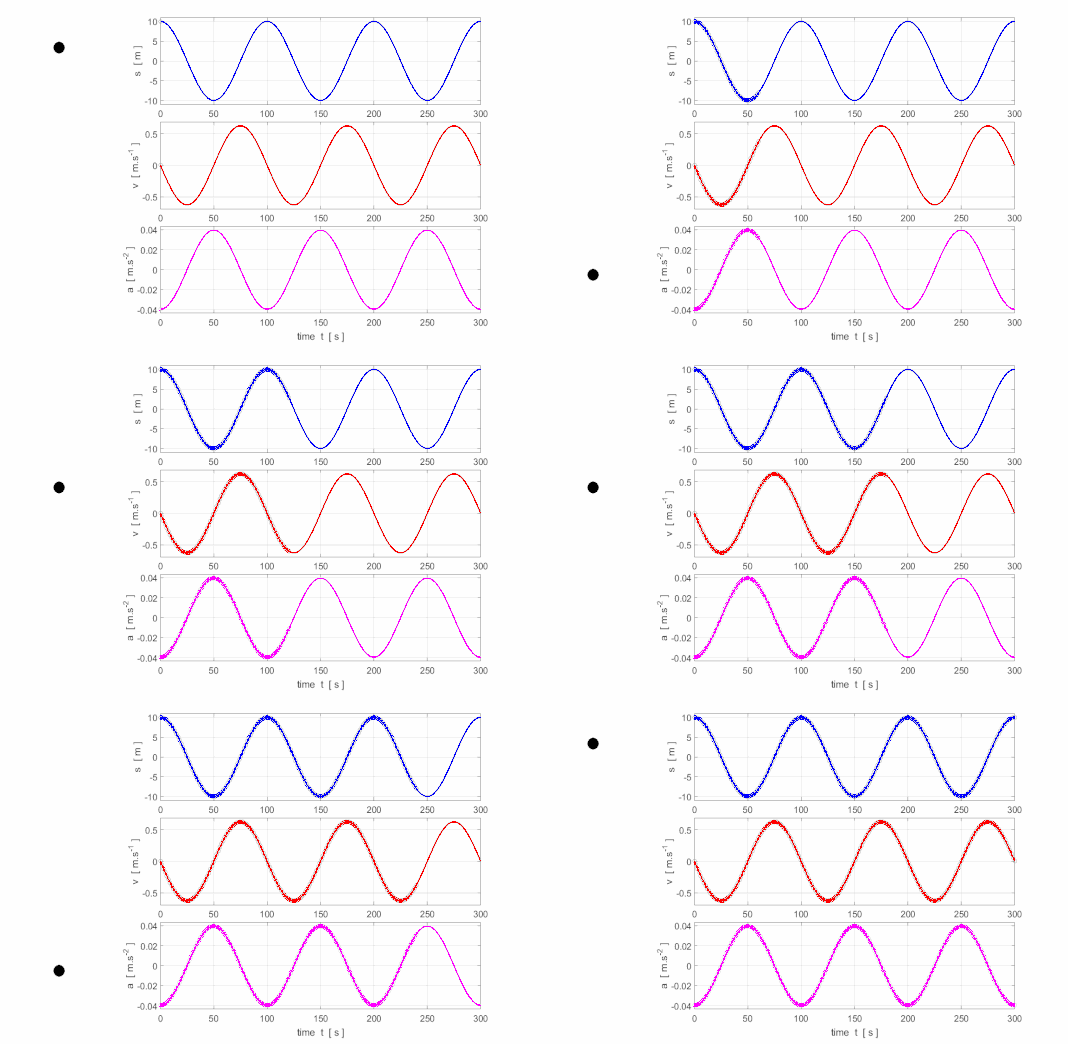
These graphs are sinusoidal in nature and, specifically, the displacement graph looks like the cosine function. So,
integrate ⇧ ⇩ differentiate
integrate ⇧ ⇩ differentiate
So, the central equation for simple harmonic oscillation is,
- where
- is the displacement of the particle from equilibrium in metres, m;
- is the amplitude of the oscillation, i.e., the maximum displacement, in metres, m;
- is the velocity of the particle in metres per second, ms-1;
- is the angular frequency in radians per second, rad s-1;
- is the acceleration of the particle in metres per second squared, ms-2;
- and
- is the passing of time in seconds, s.
Taking the expression for velocity,
We can rewrite as follows:
Maximum Values
For the maximum is at the maximum displacement from equalibrium. i.e.,
For maximum speed, it is known that if , then is at a maximum. So, using , we get
The acceleration, , is directly proportional to the displacement, (see above). We know from above that , so,
Definite pattern there, so potentially easy to remember
Questions:
Simple Harmonic Motion Questions
(care of mmerevise.co.uk)
SHM MCQ
(Care of www.savemyexams.com)
Edexcel Oscillations MCQ
(Care of www.physicsandmathstutor.com)
Edexcel Oscillations
(Care of www.physicsandmathstutor.com)
OCR-A 5.3 Oscillations Questions
[ MS ]
(Care of www.physicsandmathstutor.com)
... Search for more ...
(Care of duckduckgo.com)
Resonance
Tacoma Narrows Bridge Collapse
Questions:
Forced Vibrations and Resonance
(Care of mmerevise.co.uk)
Resonance Questions with Answers
(Care of www.showmethephysics.com)
Forced Vibrations and Resonance Questions
(Care of www.revisely.com)
... search for more ...
(Care of duckduckgo.com)
Circlular motion
For a particle moving in a circle path at a constant speed then
- where
- is the speed of the particle in metres per second, ms-1;
- is the radius of the circular path in metres, m;
- and
- is the time period of the circular motion in seconds, s.
The angular speed is given by
- where
- is the angular speed of the particle in radians per second, rad s-1.
So ...
or
The position of the particle traversing a circular path centred on the origin is given by
integrate ⇧ ⇩ differentiate
integrate ⇧ ⇩ differentiate
Now , so the magnetude of is