A fluid is a liquid, gas, or other material that may continuously move or flow under an applied shear force, or external force. They are substances which cannot resist any shear force applied to them.
Pressure
Prerequesite
Describing Pressure
or
- where
- is the pressure on a surface in pascals, ;
- is the force applied perpendicular to the surface in newtons, ;
- and
- is the area of the surface in square metres, .
The rearrangements:
Questions:
Follow on reading
Mechanical Stress
(Care of www.savemyexams.com)
Further reading:
Pascals principle
(Care of en.wikipedia.org)
Pressure at Depth in a Liquid
Young's Modulus
(Care of en.wikipedia.org)
Viscosity
Viscosity is a physical property of fluids. It shows resistance of the fluid to flow. In a simple example, water has a low viscosity, as it is "thin".
Syrup and tar, on the other hand, have a high viscosity, as they are "thick". A way to test for viscosity is the speed at which the substance runs down a slope.
Syrup would reach the bottom very slowly, and water would be much quicker.
(See simple.wikipedia.org/wiki/Viscosity for more)
Stokes' Law
Stokes' Law is an empirical law for the drag force exerted on a small spherical object moving slowly through a viscous fluid.
- where
- is the drag force on a sphere in newton, ,
- is the viscosity of the fuild the sphere is falling through,
- is the radius of the sphere in metres,
- and
- is the velocity of the sphere through the fluid in metres per second, .
This equation is only valid for small spheres at low speed with laminar flow (i.e., without turbulent flow).
In general, the visocity of a fluid depends on the temperature. Most fluids become less viscose as the temperature increased.
Density, Viscosity and Drag
[
MS
]
(Care of www.physicsandmathstutor.com)
States of Matter
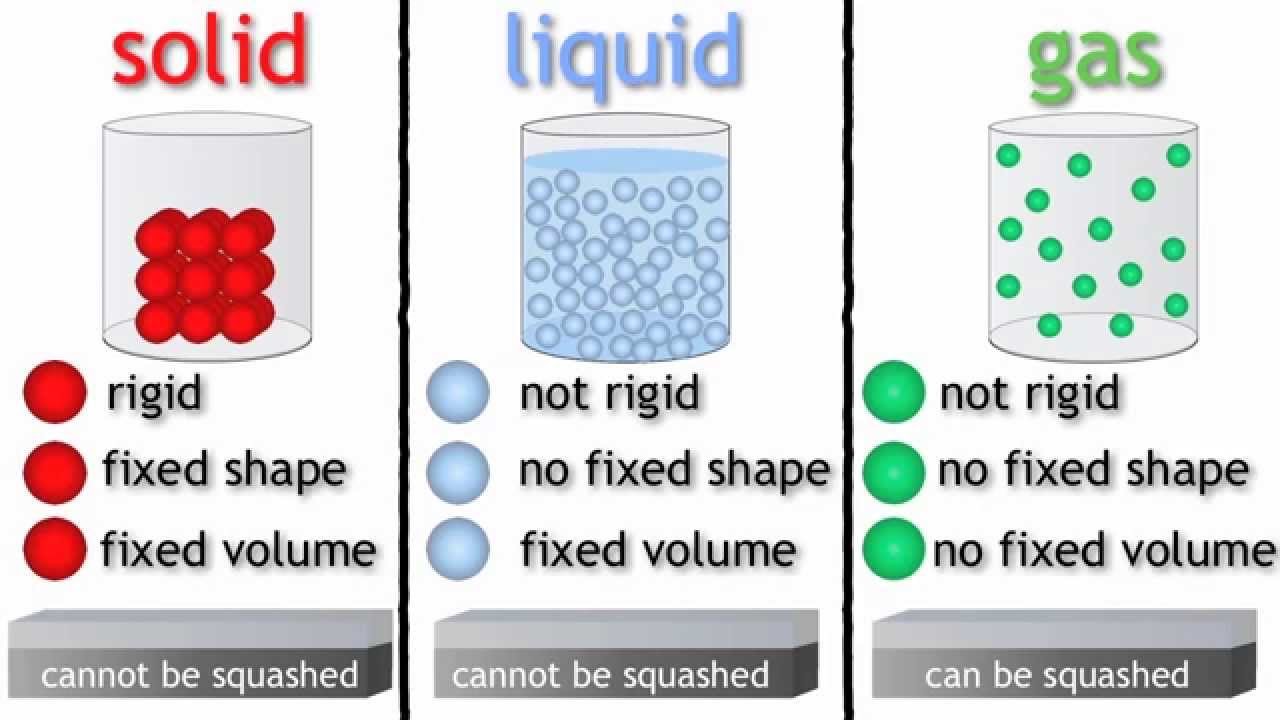
These are three of the four classical states of matter. The fourth is Plasma.
Heat and Temperature
Specific Heat Capacity
- where
- is the change in internal energy (joule, J);
- is the mass of the material (kilogram, kg);
- is the specific heat capacity (joules per kilogram per kelvin, Jkg-1K-1);
- and
- is the change in temperature (kelvin, K).
Each state of matter has a different value of specific heat capacity for each type of material
Latent Heat
of fusion and vapourisation
- where
- is the change in internal energy during a state change (joules, J);
- is the mass of material changing state in kg;
- and
- is the latent heat of fusion, or vapourisation, (joules per kilogram, ).
The latent heat has different value for each state change and for each material.
Gas Laws
for a fixed mass of gas

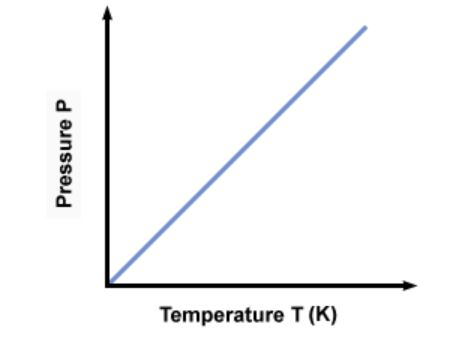
- where
- is the gas pressure in pascals, Pa;
- is the volume of the gas in cubic metres, ;
- and
- is the temperature of the gas in kelvin, K.
For a given amount of gas we can consider situations before (1) and after (2) a change
... search for GCSE Boyle's Law Questions ..
Ideal Gas Law
If , then , so
Brownian Motion
Kinetic Theory of Gases - Assumptions:
- Large number of particles;
- particles are in continuous, rapid, random motion;
- All collisions are elastic;
- Volume of particles is negligible compared to the volume of the container;
- there are no intermolecular forces except when particles collide;
- collision times are negligible compared to the time of flight.
For each assumption remember the supporting evidence.
Density form of the kinetic model equation
Pressure at Depth in a Liquid
- where
- is the pressure in pascals, ;
- is the density in kilograms per cubic metre, ;
- is the gravitational field strength in metres per second squared, ;
- and
- is the height in metres, .