Gravitational and Electric Fields Compared
| Type of Field | Gravitational | Electric |
|---|---|---|
| Force between | Objects with mass | Objects with charge |
| Constant of Proportionality | is a physical constant | Note: is a physical constant |
| Field Strength in a Radial Field | is a vector and is the graviational field strength. | is a vector and is the electric field strength. |
| Definition of Field Strength | Force per unit mass is a test small test mass. | Force per unit charge is a test small test charge. |
| Force in a Radial Field |
Always attractive This is a vector |
Can be attractive or repulsive This is a vector |
| Potential in a Radial Field |
Always less than zero.
This is a Scalar |
Sign depends on charges
This is a Scalar |
| Definition of Potential | Work done in bringing a unit mass from infinity to the point in the field. | Work done in bringing a unit positive charge from infinity to the point in the field. |
| Potential for a Uniform Field | ||
| Potential Energy |
Linear Accelerator
(LINAC)
Prerequiste Materials:
Electric Fields
(Care of revisionworld.com)
Alternating Currents
(Care of www.savemyexams.com)
Describing a LINAC
A linear particle accelerator (often shortened to linac) is a type of particle accelerator that accelerates charged subatomic particles or ions to a high speed by subjecting them to a series of oscillating electric potentials along a linear beamline. The principles for such machines were proposed by Gustav Ising in 1924, while the first machine that worked was constructed by Rolf Widerøe in 1928 at the RWTH Aachen University.
- Linacs have many applications:
- they generate X-rays and high energy electrons for medicinal purposes in radiation therapy;
- serve as particle injectors for higher-energy accelerators;
- and are used directly to achieve the highest kinetic energy for light particles (electrons and positrons) for particle physics.
The design of a linac depends on the type of particle that is being accelerated: electrons, protons or ions. Linacs range in size from a few tens of centimetres in cathode ray tubes (which is a type of linac) to the 3.2 km long linac at the SLAC National Accelerator Laboratory in Menlo Park, California.
(Above scrapped from en.wikipedia.org/wiki/Linear_particle_accelerator)

Velocity Selector
Prerequisite Materials:
Definition of the force in an electric field,
Magnetic Field Strength,
Velocity Selector (or Wien Filter)

Derivation of the Velocity Selector Equation
The forces on the charged particle passing through the velocity selector due to the electric, , and magnetic field, , are opposite directions. For a particle of the selected velocity these forces are also equal in magnitude.
Follow on and further study:
Mass Spectrometer
Velocity Selector Video
Cyclotron
Prerequisite Materials:
Force on a charged particle due to an electric field.
(care of www.savemyexams.co.uk)
Force on a charged particle due to a magnetic field.
(care of www.savemyexams.co.uk)
Describing Cyclotrons
Particle Accelerators
(care of www.savemyexams.co.uk)
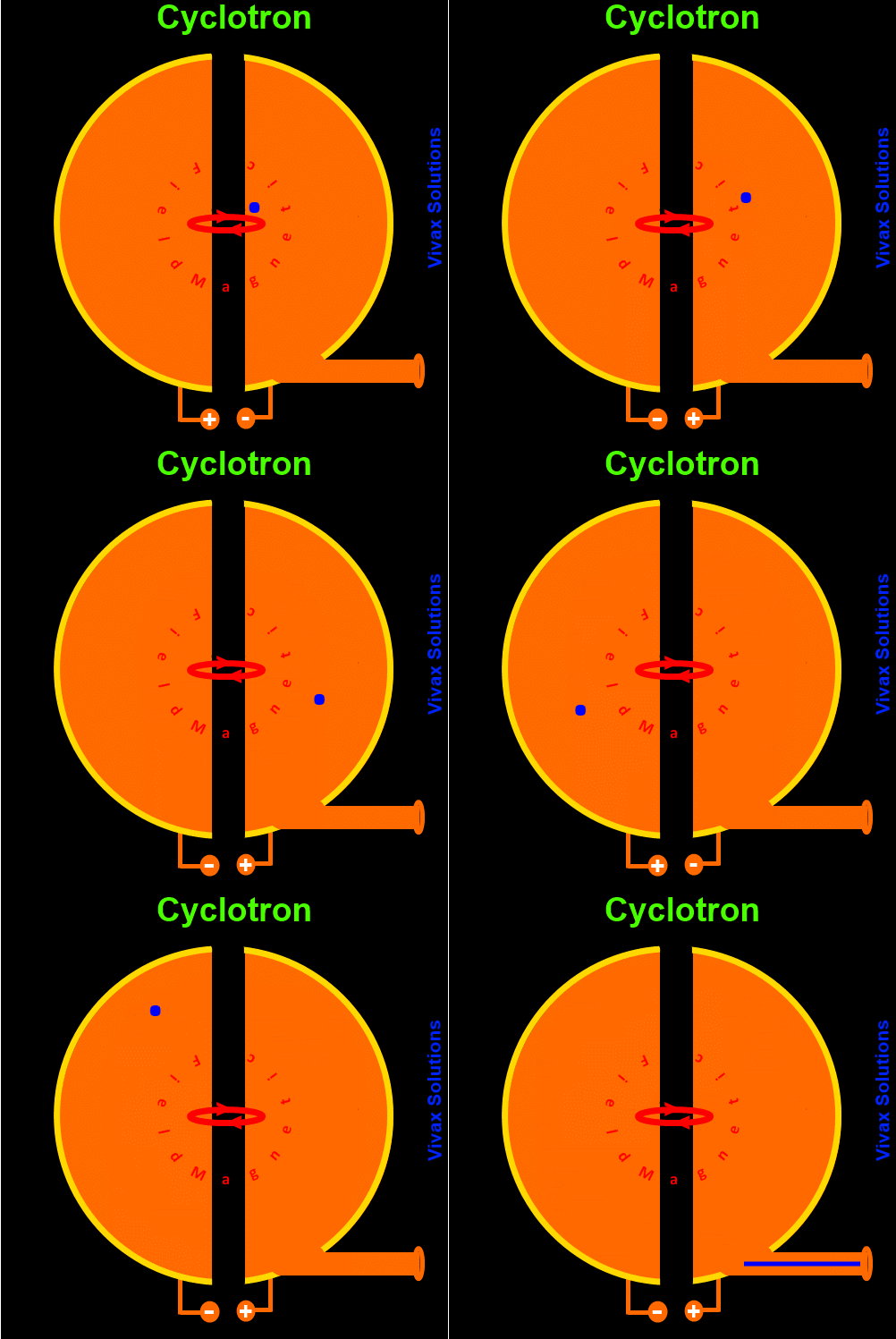
(care of www.vivaxsolutions.com)
Cyclotron - working principle & construction - Moving charges & magnetism
(care of www.khanacademy.org via www.youtube.com)
Particle Accelerator Questions
(Care of en.wikibooks.org)
Follow on Materials:
Particle Collisions
(care of www.savemyexams.co.uk)