Electronic Components
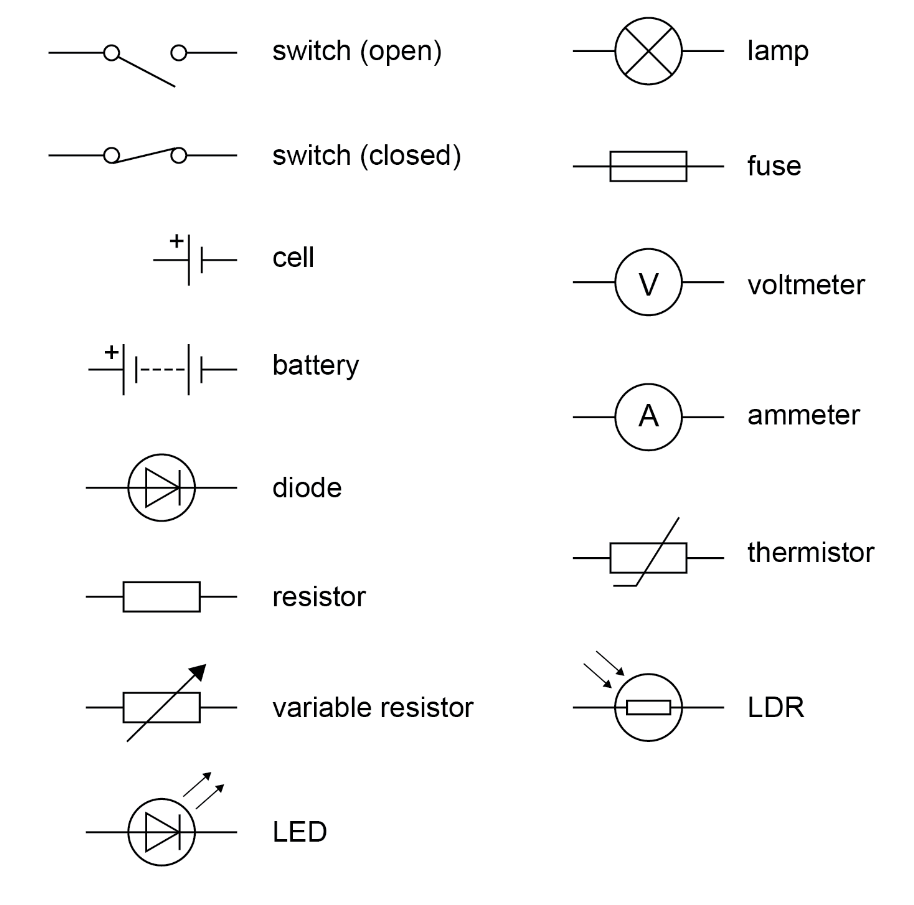
Circuit Diagram Symbols
(from studyrocket.co.uk)
I-V Characteristics
Investigating I-V Characteristics
Diodes
(from cyberphysics.co.uk)
Resisitance
Prerequisite Materials:
Current
Potential Difference
(Care of www.gcsephysicsonline.com)
Resistance - defining equation - Ohm's Law:
- where
- is the potential difference across the component in volts, ;
- is the current through the component in amperes, ;
- and
- is the resistance of the component in ohms, .
The Rearrangements
Ohm's Law
(Edexcel GCSE)
(from studyrocket.co.uk)
Ohm's Law
(for CIE A Level)
(from www.savemyexams.com)
Current
Definition of Electrical Current
(AKA Conventional Current)
(from simple.wikipedia.org)
- where
- is the electrical current in amps, ;
- is the charge that is moving in coulombs, ;
- and
- is the time taken, for the flow to occur, in seconds, .
-
Kirchhoff's Current Law, and Kirchhoff's e.m.f and p.d. Law
from isaacphysics.org;
-
See electron flow
from alevelphysics.co.uk.
Questions
Electrical Charge-and Current
(Care of mmerevise.co.uk)
Circuits, Charge and Current
(Care of revisionscience.com)
Current
(Care of www.savemyexams.com)
Mains Electricity
Mains Electricity
(Care of mmerevise.co.uk)
Revision Questions
(Care of www.gcsescience.com)
Mains Electricity
(Care of studymind.co.uk)
Electrical Power
Warm-up Materials:
Describing Electrical Power
- where
- is the electrical power delivered to the component, in watts, ;
- is the electrical current passing through the component, in amperes, ;
- and
- is the potential difference across the component, in volts, ;
The Rearrangements
Other Forms
Using Ohm's Law we can express electrical power as
or
This equation can be derived from the equation for mechanical power along with the definitions for both current and potential difference
Combining these three ...
Questions:
Power
(Care of mmerevise.co.uk)
Energy and Power in Circuits
(Care of www.savemyexams.com)
The Charge Transport Equation
- where
- is the current in amperes, ;
- is the number of charge carriers per unit volume, ;
- is the cross-sectional area perpendicular to the current flow, ;
- is the charge on each carrier in coulombs, ;
- and
- is the drift velocity of the charge carriers, .
Derivation
Imagine a cuboid conductor of cross-sectional area and length with current flowing through it perpendicular to the cross section.
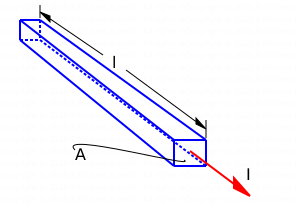
The material that makes the cuboid has, charge carriers per unit volume. As we are considering a metal conductor, these charge carriers are electrons, each with charge .
The amount of charge per unit volume is en, and the volume is , so the total charge is .
We can think of the electron travelling long the conductor with an average velocity of , so the time taken, for the electron to travel the length, is .
Now, the electric current is given by .
Substituting the above into the equation for current,
Which simplifies to
As required
Potential Difference and emf
Prerequesite Materials:
Work Done
Charge and Current
(care of mmerevise.co.uk)
Describing Potential Difference
- where
- is the potential difference across the component in volts, ;
- is the work done by the charge passing through the component in joules, ;
- and
- is the amount of charge passing through the component in coulombs, .
The voltage is a general term for potential difference and emf and where the context is clear can be used in stead of these.
Questions:
Current, Potential Difference and Resisitance
(care of www.savemyexams.com)
Electromotive Force (emf)
which looks the same as potential difference, but here is the work done on the charge passing through a supply of energy.