Warm up:
Describing Vectors:
Vectors differ from scalars in that unlike scalars, who have magnitude (size) only, vectors have both magnitude and direction.
Both addition and subtraction of vectors is possible, e.g., .
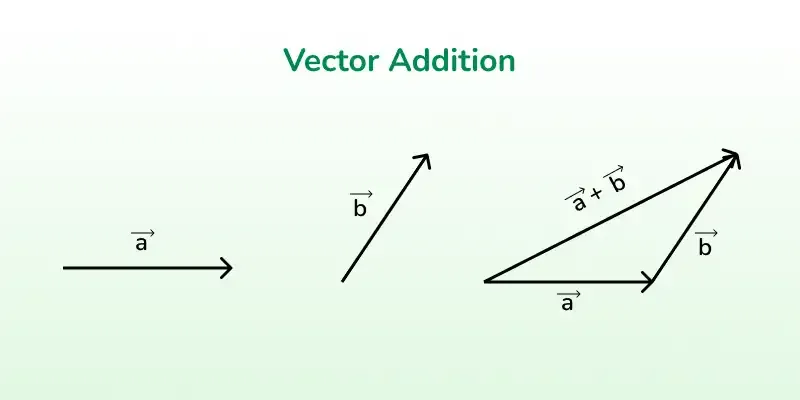
Multiplication is a little more interesting. We can have scalar multiplication, where is a scalar.
There are two types of multiplication of vectors by vectors.
Videos and Questions:
- Vectors Video
- Practice Questions [MS]
- Column Vectors Video
- Practice Questions
- Textbook Exercise
- See also:
- Translation Vector Video
- Practice Questions
- Textbook Exercise
The Length of a Vector
The length of a vector in two dimensions can be found by using the pythagorean theorem
- where
- is the length/size/magnitude of the vector;
- and
- and are the components of the vector in the respective axis directions.
Similarly in three dimensions
Here the , and are the components of the vector
Unit Vectors:
The vector has a magnitude of one and is in the same direction as
There are a set of orthogonal unit vectors called , and .
and points in the direction of the x-axis.
and points in the direction of the y-axis.
and points in the direction of the z-axis.
These are useful for describing vectors in cartesian space.
Position Vectors
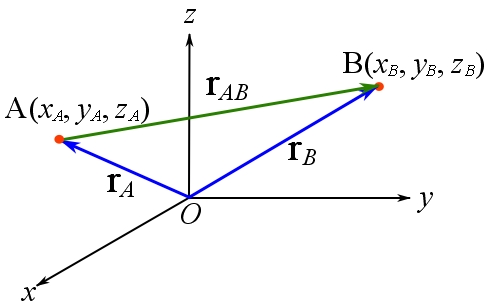
The vectors and are position vectors. They, like all position vectors, start at the origin, and finish at the point of interest. is not a position vector as does not start at the origin.
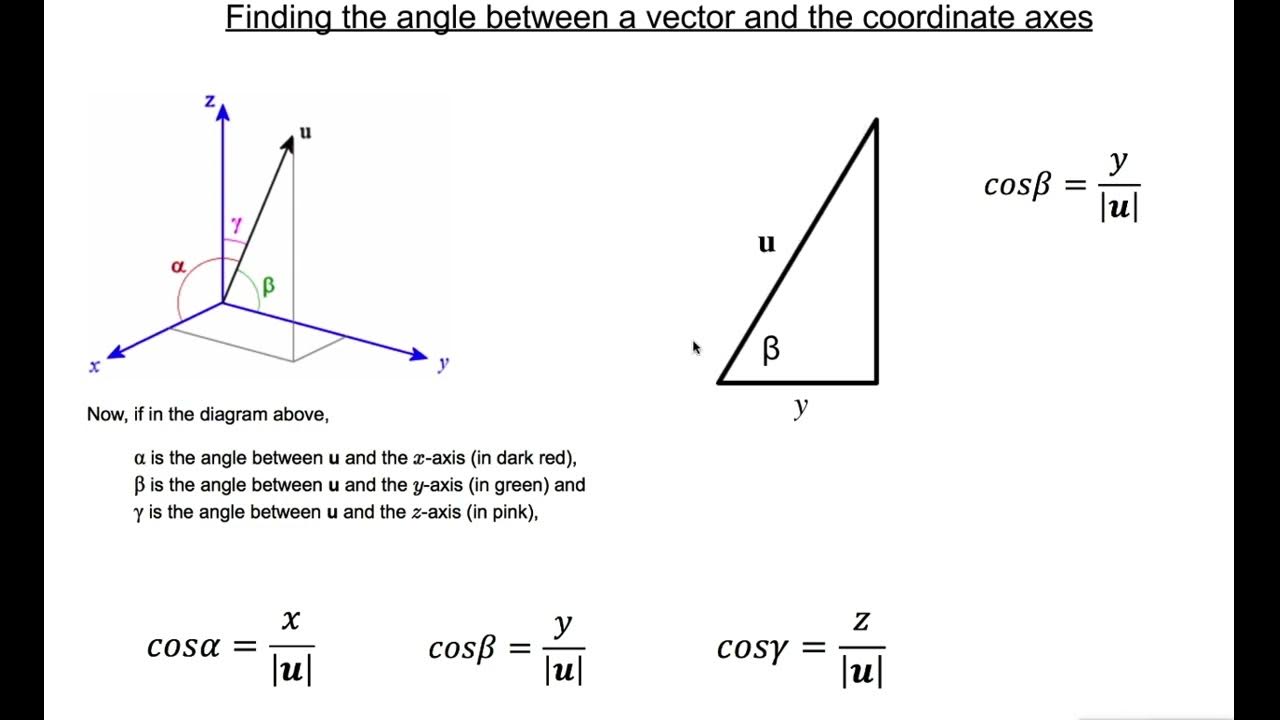
If the vector makes an angle with the positive -axis then and similarly for the angles and .
Comparing Vectors
Two vectors can be equal in which case both their magnitudes (sizes or lengths) and directions are the same, i.e., parallel, .
They may be in the same direction, but have different magnitudes, these two are said to be parallel. In this case one vector is a scalar multiple of the other.
Vectors with different directions may be of the same magnitude.
Resolving Vectors (from alevelphysics.co.uk)
The vector equation of a straight line:
- where
- is the position vector of somewhere along the line;
- is the position vector of a point, , the line passes through;
- is a scalar parameter;
- and
- is a direction vector in which the line points.
The parameter is a measure of the multiples of that the point is along the line from .
An alternative equation of a straight line passing through the points and , with position vectors and respectively, is
If and , the equation of the line with vector equation
can be given in Cartesian form as:
More Notes with Questions
Equation of a Line in Vector Form
(Care of www.savemyexams.co.uk)
A general point in a plane is given by the vector equation
- where:
- is the position vector of a point in the plane;
- is the position vector of another (reference) point in the plane;
- and are non-parallel vector in the plane;
- and,
- and are parameters.
- The distance from the origin to the point is
- The distance between the points and is
- Any 3D vector can be written in column form as
Matrices
Matrices Questions
(Care of www.physicsandmathstutor.com)
Matrices Questions
(Care of www.revisely.co.uk)
- Multiplying Matrices by a scalar
- Practice Questions [MS]
- Multiplying Matrices a 2×2 by 2×1
- Practice Questions [MS]
- Multiplying Matrices a 2×2 by 2×2
- Practice Questions [MS]
- Identity Matrix
- Practice Questions [MS]
- Transforming the Unit Square
- Practice Questions [MS]
- Matrix Transformations
- Practice Questions [MS]