Describing Straight Lines:
Drawing Linear equations
Vertical Lines:
where is some constant, e.g., . This is the equation of a vertical straight line. The more positive is the more the vertical line is to the right. The more negative, the more the vertical line is to the left.
Horizontal Lines:
where is some constant, e.g., . This is the equation of a horizontal straight line. The more positive is the higher the horizontal line is. The more negative, the lower the horizontal line is.
Lines at other Angles:
where and are constants, i.e.,
is the gradient of the line.
is the y-axis intercept [ is the x-axis intercept]
Gradient of a Line:
The Equation of a Line:
These are some of the ways the equation of a line maybe written:
As seen above, is one of the most useful presentation.
Notice that both and have an index one, i.e., there are no other indices in any terms.
Length of a line
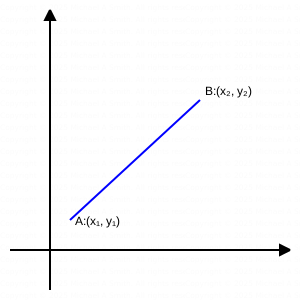
Mid Point of a Line:
Linear Graphs
- In real life
- Across one method
- Practice Questions
- Textbook Exercise
- Finding the equation of a line
- Practice Questions
- Textbook Exercise
- Equation through 2 points
- Practice Questions
- Textbook Exercise
Comparing Lines: Parallel and Perpendicular Lines
For two or more lines are three possibilities for any pair. Lines and
have equations
and
can either be parallel to each other (at an angle of 0° to each other), perpendicular to each other (at 90° to each other), or some other angle.
For parallel lines the gradients are equal, i.e., .
For perpendicular lines the product of the gradients of the lines equal minus one, i.e.,
Equation of a Perpendicular Bisector
- To find the perpendicular bisector of a line segment between two given points:
- Find the gradient of the line segment between the two points;
- Find the gradient of the perpendicular using ;
- Find the mid point of the two given points. The perpendicular bisector goes through this mid point;
- To find the y-intercept of the perpendicular bisector substitute the mid point coordinates in the equation for the bisector.